👋🏻 Hello
Hello 🙂
Hello…
(Is there an echo in here?)
What’s this?
It’s an introduction to an idea I’ve got 🪴
OK, I like ideas…
…but it looks like you’ve made a website that shows an entirely imaginary conversation between us…?
Yeah. It ended up being easier than writing a document to explain it all.
And… what’s it all about?
Well… it’s called Lifespan. And it’s…
…
…it’s like OpenStreetMap for time and a personal temporal Wikipedia.
That was me trying to boil it down to one sentence.
Let me think about that for a second.
…
Right. It might take a bit more than one sentence…
I know. That’s the thing.
Let’s try another section.
🕰️ Time
What just happened?
I’m taking it step by step.
So you broke up the conversation into sections?
Yes. But it’s not like you have to read all of this in one go.
Fine. But are you going to get on with it or what? 🙃
I’m just working up to it.
OK. So time is a big and important thing, right?
Yes…
Well, the idea is to create a way of mapping and exploring time, for yourself and for everyone and everything.
What do you mean?
A way to see, explore and document your own life alongside public history, and do the same for public history through the lens of your own life.
That sounds… well… I’m not sure yet.
What does that mean?
Lots of different things. It’s quite big.
Imagine being able explore things like:
- What was this person I’ve just watched a programme about doing when they were my age?
- What was I doing when they did that thing that they did?
- What were other people doing at that time?
…and… I dunno…
- What was my mum doing when The Beatles released Sgt. Pepper?
…things like that.
Rabbit-holes to disappear down in the same way you can disappear down Wikipedia rabbit holes.
You can click on links, by the way, I’ll wait :-)
Ah, OK… rabbit holes.
But slow down… I have so many questions.
Who’s this for? What problem are you trying to solve here?
I don’t 100% know yet. That’s one reason why we’re here.
I think it’s trying to solve a problem that people don’t necessarily know they have yet.
I call it the archive problem - but I haven’t written the part of the conversation where we talk about that.
Yet.
But it’s why this all matters.
OK. For now, let’s try a different angle…
Why are these rabbit holes you’re talking about different or interesting?
Because I think those
X-Y-Zcomparisons (what wasXdoing whenYwas doingZ?) are all around us, and underpin a lot of the things that we find deeply significant… even if we don’t realise it.
What do you mean?
Think about how often we collectively celebrate the anniversaries of cultural or historical milestones…
…and how they make us think “what was I doing then…?” or “what would I have been doing then…?”
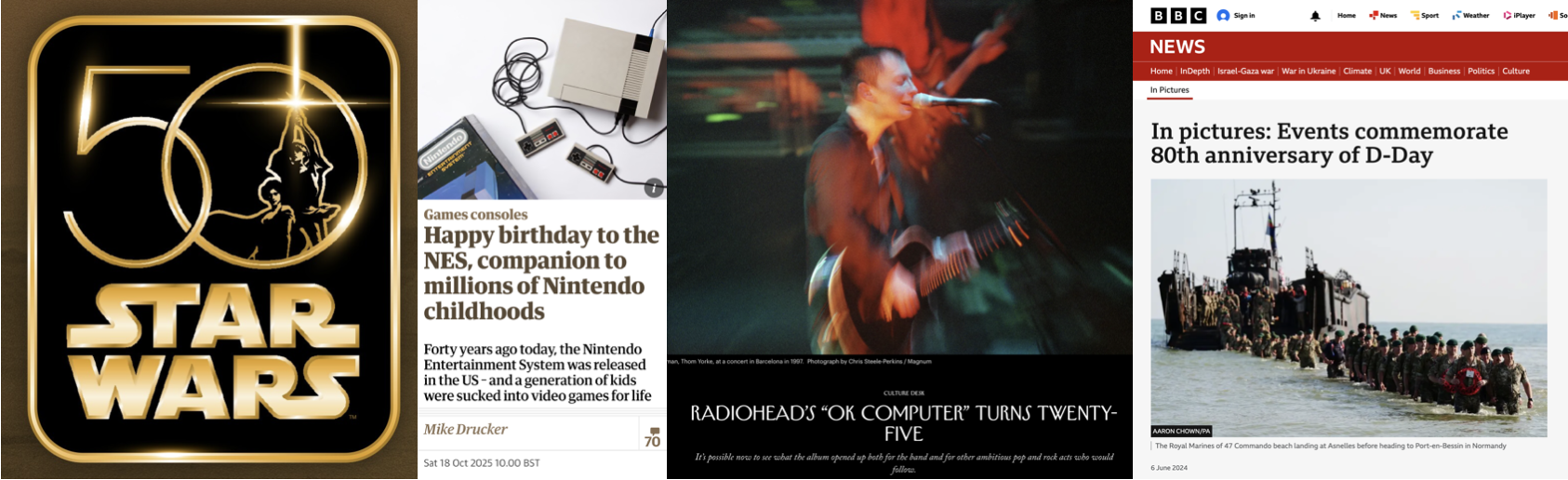
Yeah, I sometimes think we live as if time and biography were the very organising principles of meaning…
…and that we’ve never built any form of web infrastructure that treats them that way.
Well… yeah, exactly.
(How did you know I was going to say that?)
You’re writing all this.
Oh yeah.
Another section, do you think?
OK. I’m ready.
💡 Idea
So yes… time and biography… the organising principles of meaning…
Yeah, the books, films, music… all the media we love most are all kind of time machines.
All those podcast interviews, history documentaries, diaries by politicians, films about Bruce Springsteen or Bob Dylan… gallery retrospectives… are ways of navigating through the story of people’s lives… reconstructing and tracing what led to what.
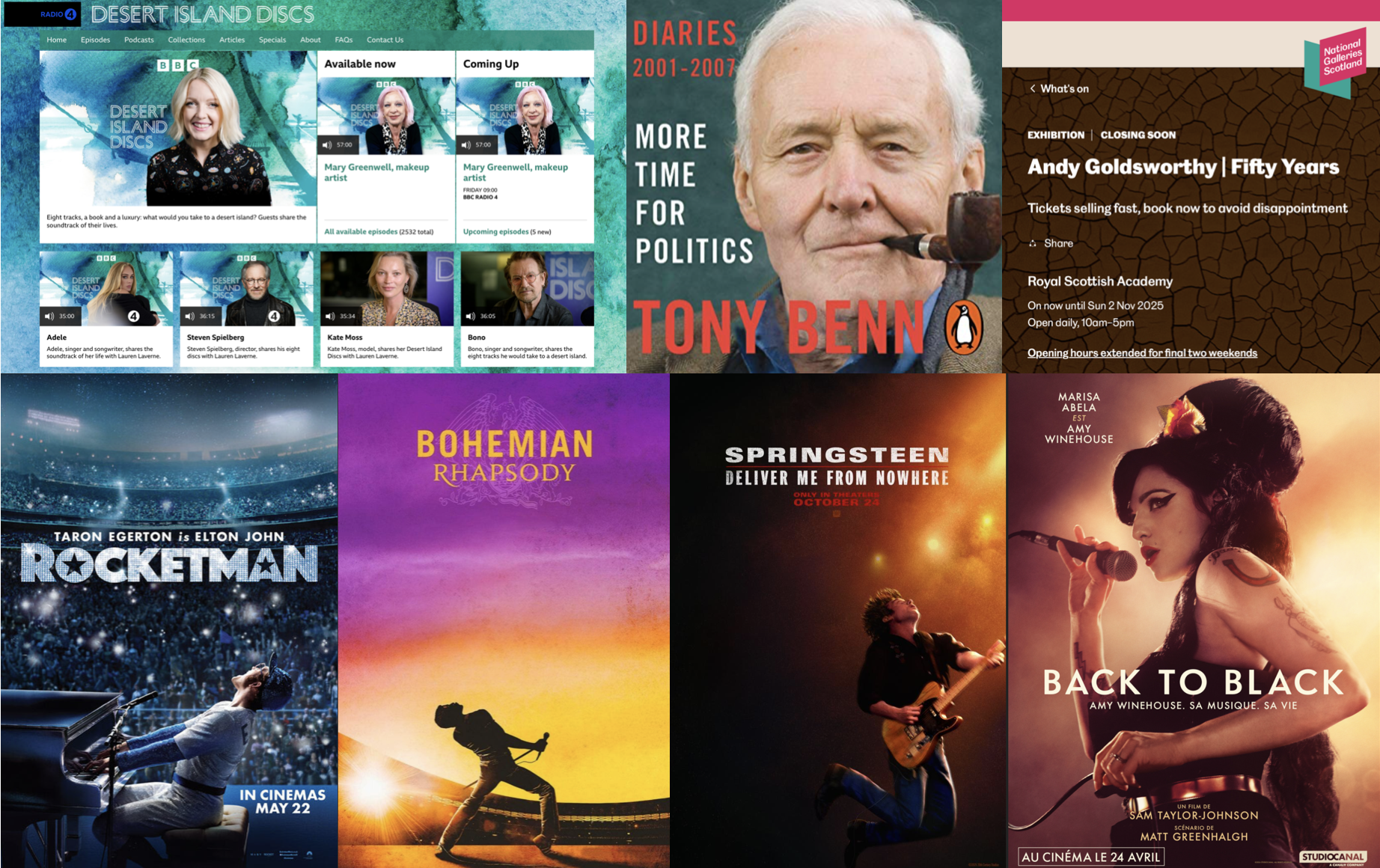
Yes. And Lifespan would take the same raw material and turn it into a shared, navigable, generative web-thing.
OK, and this is what you mean by “OpenStreetMap for time and a personal temporal Wikipedia”?
Yeah. But there’s a lot of other stuff.
What other stuff?
That’s the question… and that’s why we’re having this conversation.
How do you make something that taps into and explores this kind of thinking?
I’m assuming you have some ideas about this?
Yes. And I’ve built a thing.
Do I get to see this thing?
Yes, yes. You really do. I just need to get some things out of the way first…
You mean things like “hasn’t this been done before?”
Things like that, yes.
And I think the answer is - surprisingly - “no”…
Wikipedia tells you about The Beatles or JFK in isolation, but not about how they intersect…
…and least of all with you.
But I don’t “intersect” with either of them, do I?
Well… we can talk about that… this is where the magic happens 🪄
Later parts of this conversation will explain this, when I’ve written them.
OK… but you’re talking about some ideas that have definitely been done before, right?
Yeah, timeline tools exist, but they’re read-only. They present information, they don’t involve you.
HistoryPin is a bit more interactive - it’s about crowdsourcing old photos - but it’s just for places, and in a pretty specific way.
Err… Facebook?
Yeah, Facebook and the rest do hold all your “life data” (if you use them), but… well, it’s very, very different. Facebook is about social networking. This isn’t that.
What about Facebook Timeline?
We could have a whole separate conversation about this…
Perhaps another time…
But I can imagine you’ll say something about…
- Facebook optimising for interaction in the moment and for addictive social engagement…
- how it treats everything as a timestamped “post”…
- and how the timeline feature is just a shallow chronological representation with no semantic depth?
- and… well… Facebook
Yeah 🤦🏼♂️
What’s different about Lifespan is that it’s not meant to be a realtime social network. It’s… more like an all-time reflective network.
It’s about zooming back and seeing the wood for the trees. And planting trees.
There’s a mirror effect, where your own time bounces off shared time, and back again.
Somehow.
We’ll come back to this 😉
I’m going to have to take your word for it…
…but you’ve built this thing, yes?
Some of it…
But as a sort of (massive) conceptual sketch.
It needs a lot more thinking 👨🏼💻
Fair enough. But…
…where did this all come from?
Well… I’ve been thinking about this for bloody ages.
It’s been the thing I think about in between doing other things, like having children and jobs and stuff.
I’ve tried lots of times over the years to prototype parts of it, but hit technical walls pretty quickly… 🚷
It needs a group of specialists, and I’m a generalist.
What happened?
AI happened ✨
This year I’ve been able to fudge together a virtual, artificial group of specialists: ChatGPT, Cursor, Claude…
…enough to get a “house of cards prototype” on its feet, stitching together lots of the ideas I’ve come up with.
House of cards? 🃏
Yeah. It stands, but it wobbles and falls over sometimes. The point is: you can finally glimpse what it might be.
And… not wanting to sound like a character from a shit film, but what do you want from me ❓
That’s the important bit.
📩 Proto
I want you to read this conversation, and then look at the prototype.
The first part seems to be going OK so far ✅
And then… you can do as much (or as little) as you’re interested in.
- First: have a proper look, and see if you can work out what’s going on 👍🏻
- Then: play a bit, and ignore the obvious gaps and broken bits… ⚙️
- And then: tell me what seems promising, interesting, bewildering or incomprehensible… ⚠️
- And: feel free to ask questions, because you’ll probably have lots… 🤔
- And if you want: help me think what this could become… and even help make it into a proper thing 🚀
Well, we’ll cross that bridge when we come to it, shall we?
So how do I see this proto-conceptual-alpha-prototype, then?
You can go to https://beta.lifespan.dev and register 🙂
And that’s it?
Your registration will need to be approved (it’s a closed beta)
But that’s it.
OK. So what’s next?
Another section, I think.
🙋🏻♀️ Next
Hello again.
So, a deeper dive?
Where to start, though?
Good question.
How about you just jump into the middle somewhere, and we’ll see if we can find our way home?
OK let’s try it. But this is just gonna be a meandering chat for now.
OK. We can just see how it goes.
Big questions might surface in the wrong order…
It’s fine.
Alright.
So, you know when you see a blue plaque?
Like these?
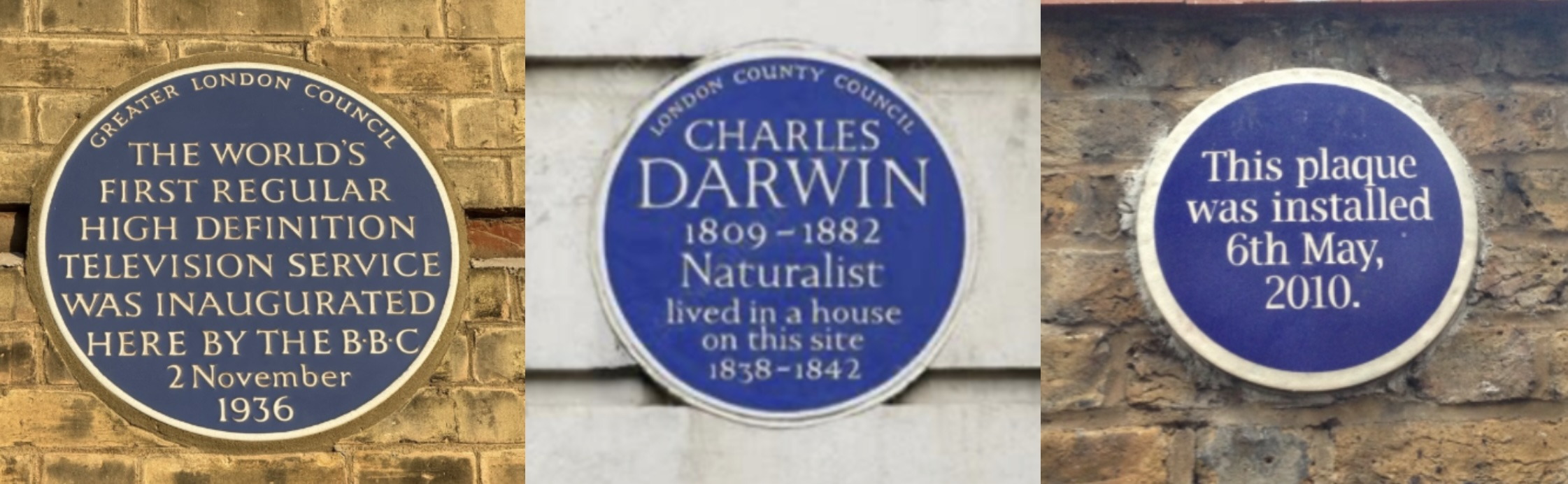
Yeah, those ones.
Well… have you noticed how you can’t click on them?
Yes. Physical objects are famously unclickable…
They are.
But imagine if they were, for a second. What information would they have to hold?
Well… you tell me. Let’s pick the Darwin one…
OK, so we have:
Charles DarwinNaturalistlived 1809-1882- “this site” (which is on
Gower Street, London, WC1E 6BT)lived at that place between 1838-1842
OK so far…
Right, so if we start at the top, and want to know about “Charles Darwin”, we can look him up on Wikipedia…
https://en.wikipedia.org/wiki/Charles_Darwin
This gives us plenty of information that we can browse, page by page.
But do you see how none of the dates are links?
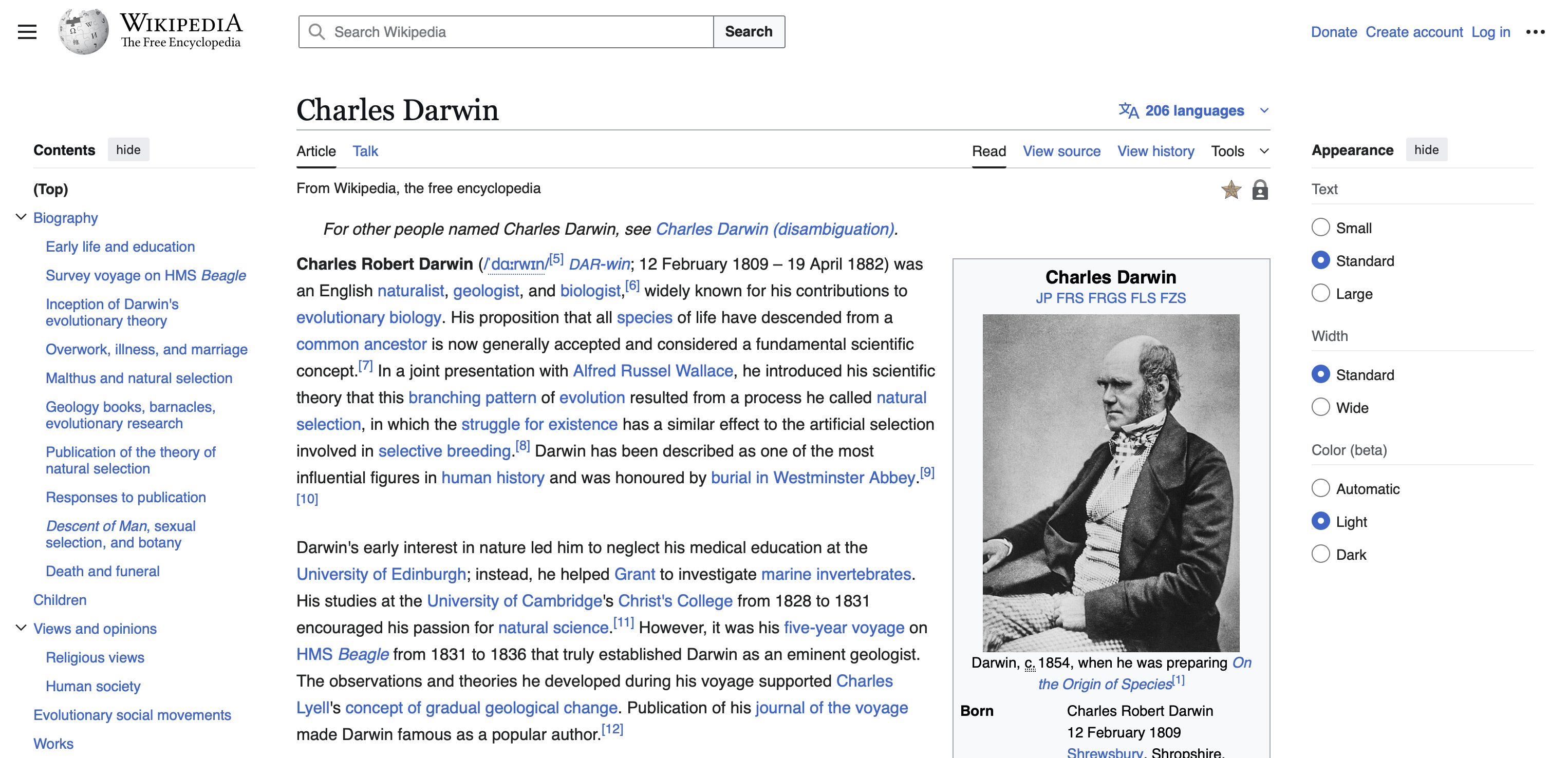
Yeah…
So what if this information was time-aware?
“His studies at the University of Cambridge’s Christ’s College from 1828 to 1831 encouraged his passion for natural science.”
This sentence is actually a few different time-related things:
- Charles Darwin (a person who lived from 1809 to 1882)
- Christ’s College, Cambridge (founded in 1437, and it still exists)
- Darwin’s time studying there (between 1828 to 1831)
So let’s draw those things like this…
While we’re here, we can do the same for other information we find…
So… we have two “education” time periods, right? Education spans, we’ll call them.


Ah, OK… “span” is an important word, right?
Very.
OK, with you so far.
So, wouldn’t it be interesting to do the same thing for yourself, and see how these things line up?
What do you mean?
Well, I just happen to have studied at The University of Edinburgh.
Oh did you now?
Yep.
And those dates don’t overlap, obviously.
Obviously.
But they kind of do, if you look at them relatively rather than absolutely.
Go on…
Well, Darwin was in Edinburgh at age 18, right?
1827 - 1809 = 18And so was I…
1994 - 1976 = 18So we’ve just found an overlap that shows that I have a connection to Charles Darwin.
Congratulations 🤓
Yeah, OK, it’s only very slightly amazing…
But what if you could apply this logic to everything?
Represent information in terms of spans of time and the things they represent, rather than just talking about the things they represent?
Like what?
OK, let’s go back to that blue plaque. We can look it up and we’ll find this https://www.english-heritage.org.uk/visit/blue-plaques/charles-darwin/
From this, we have another span, right?
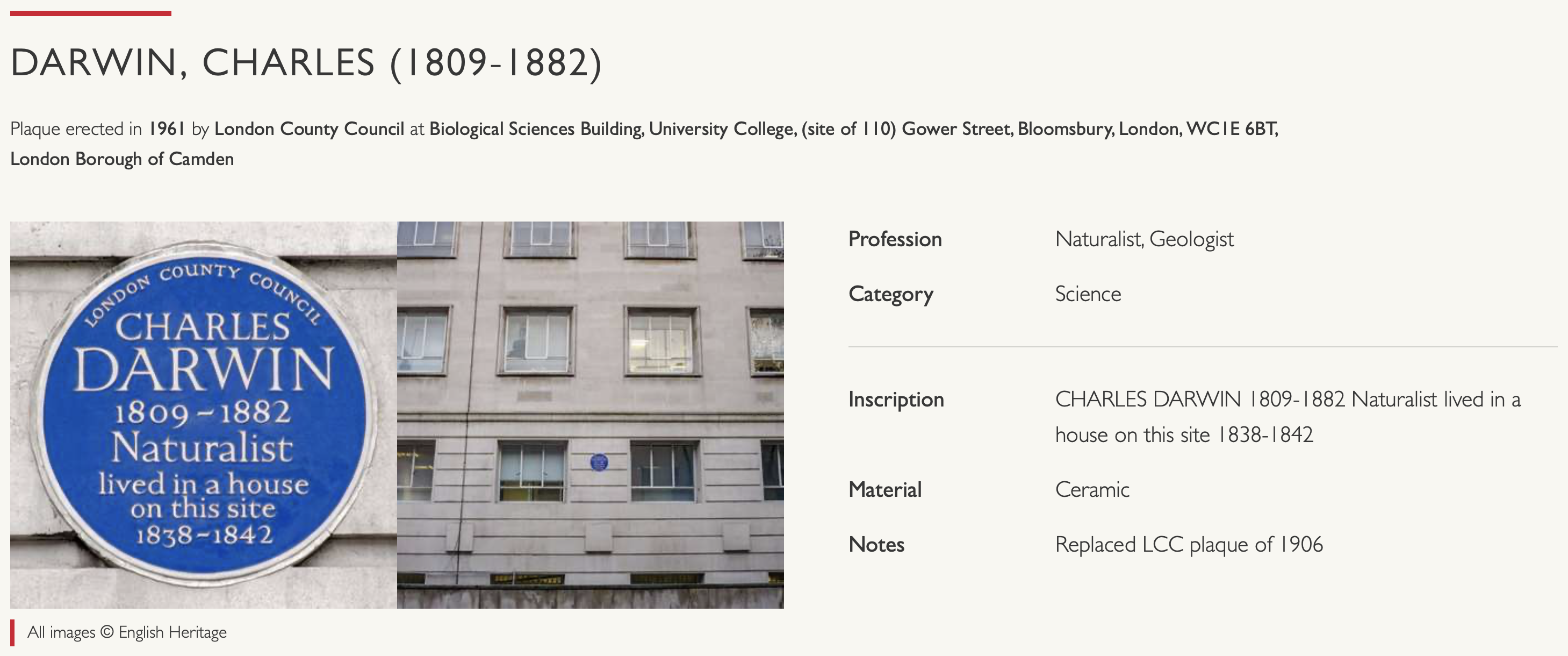

Ah yes…
But we could show this differently…
So what where was I living at this age? What would the overlap of “residence spans” look like?


A mirror effect?
Yeah.
And we could do this for all the things in Darwin’s life and my life…
And then see them in absolute time, as well…


And you’re saying we could do this for everything?
Yeah. If it’s in Wikipedia, we can bring it into Lifespan.
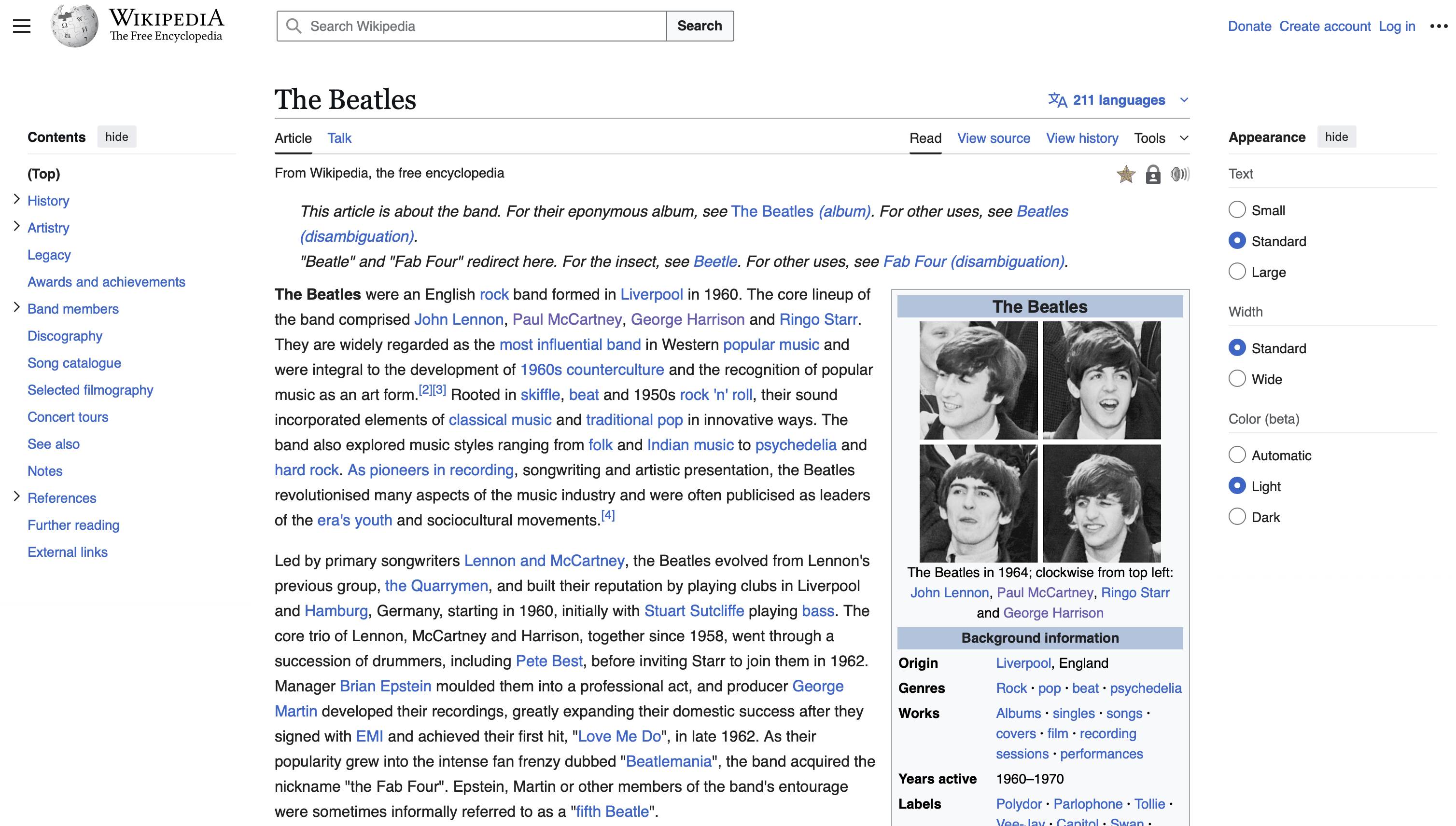
Here’s The Beatles in Wikipedia…
But in Lifespan, you can see this differently…
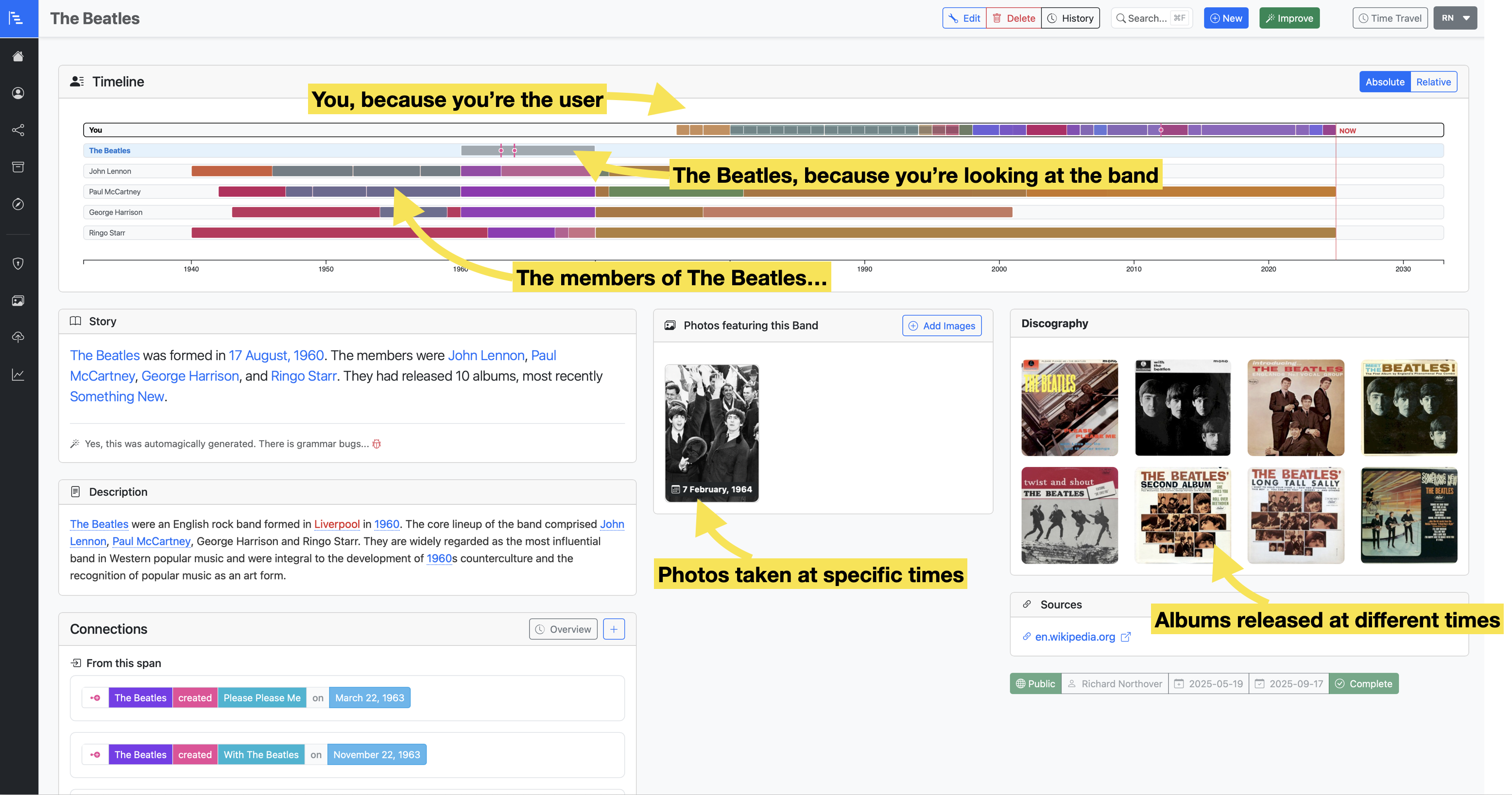
What if we try another band?
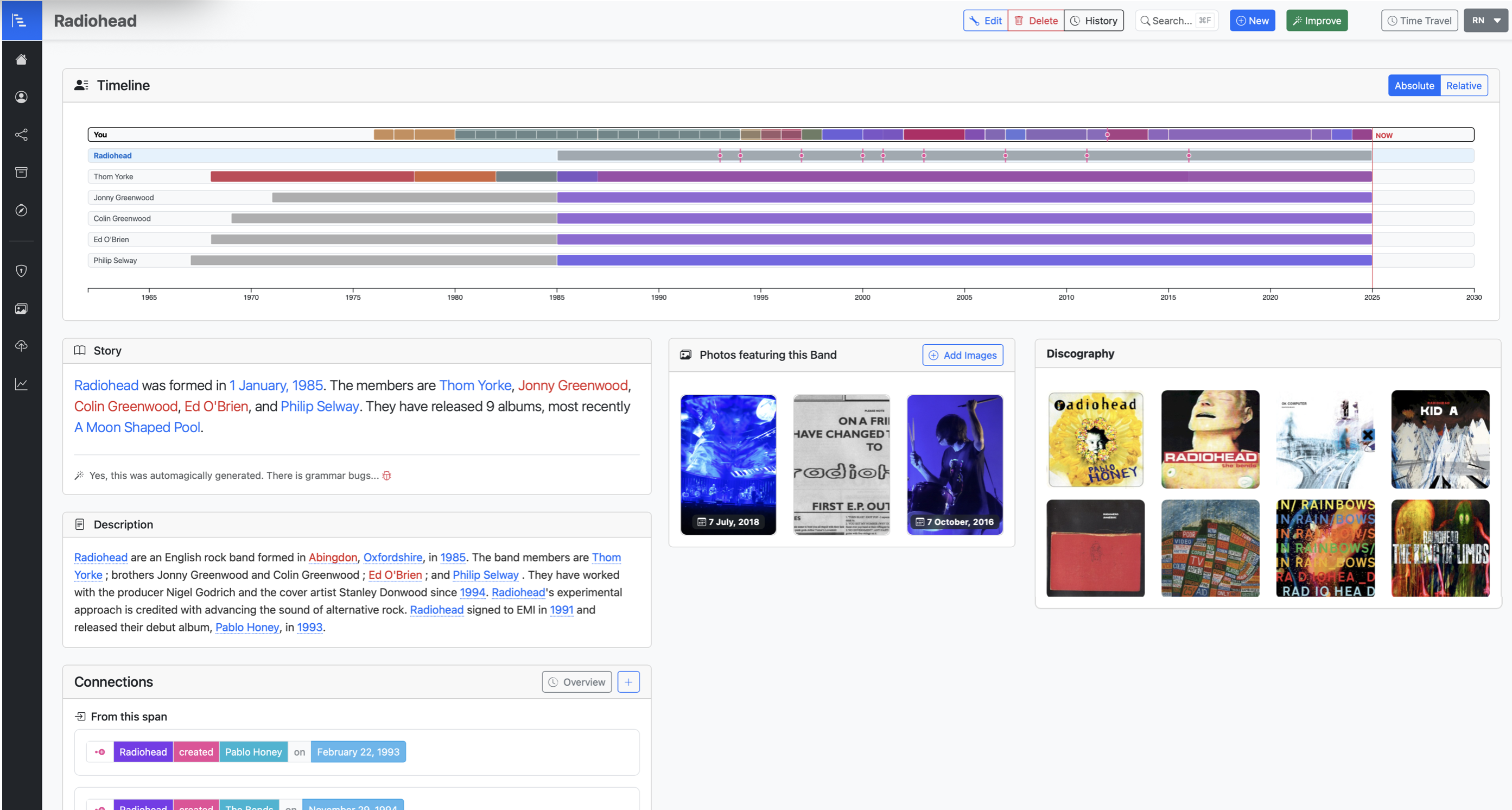
And all that just came from Wikipedia?
Yeah, and MusicBrainz. All open data with APIs.
Got it.
So Lifespan sort of brings it all together? Gives you a different perspective?
Exactly. But that’s just the tip of the iceberg.
Why are some of the timelines full of coloured lines and others not?
The same reason that some links are blue and others red… it’s like on Wikipedia, where some things are finished pages and others are “stubs”.
In Lifespan they’re called “placeholders”… the information isn’t complete enough.
I see. And looking at it, I’m thinking there different kinds of span, then?
Yes, lots.
You can actually have anything you like, but at the moment we have
people,places,organisations,bands,things…
Things?
Yeah, I should have said that there’s
typesandsubtypes.Spans of type “thing” includes
books,albums,tracks, and so on.They all exist in time. Different kinds of span have different properties, as well as the core Lifespan things (which means dates).
Show me…
OK, this is a span of type “thing”, subtype “album”…
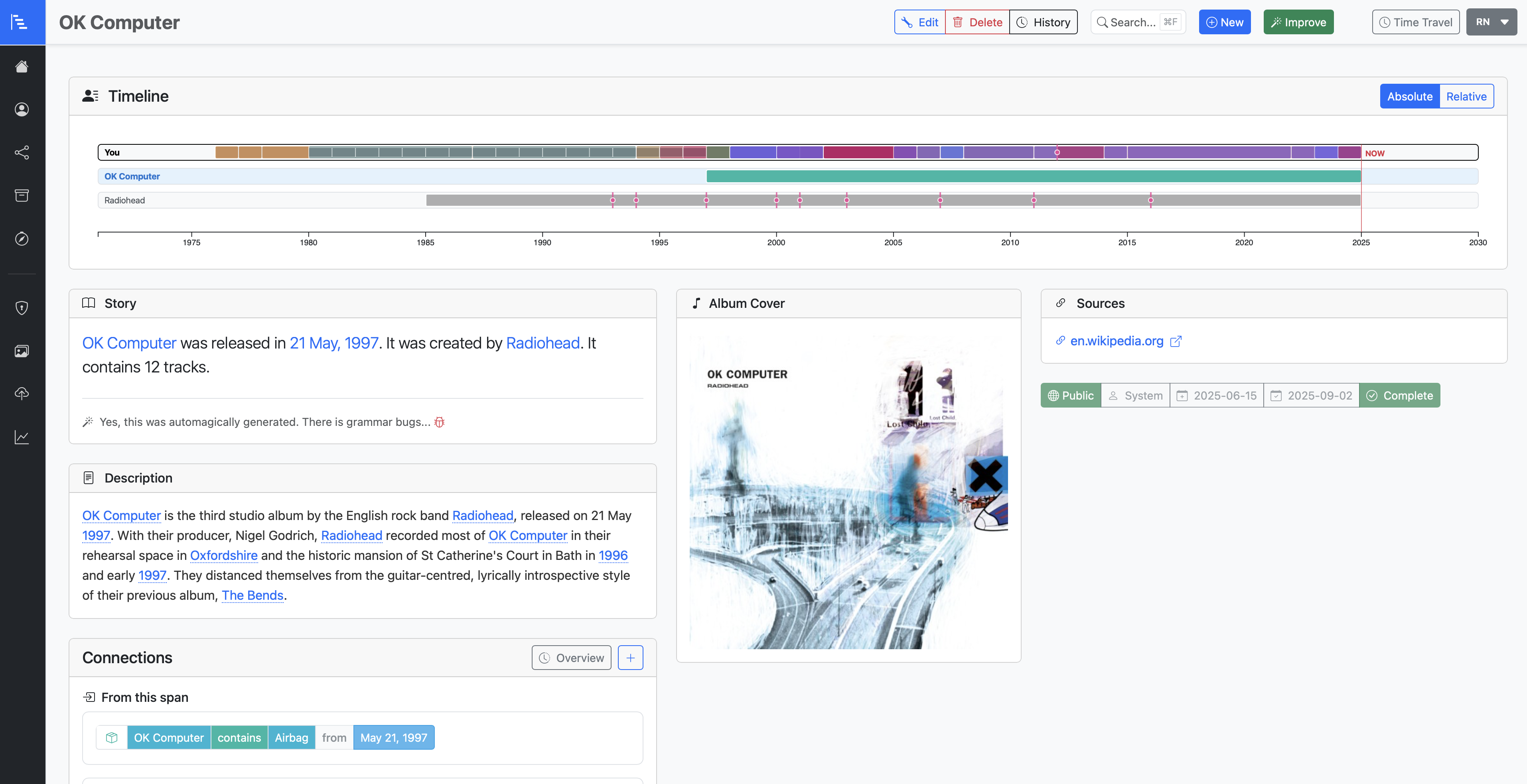
Right, I see what’s happening here!
Yes… a big network of spans, of different kinds, all related to each other.
Ah, so how do we show how they relate to each other?
Good question.
🕸️ Connections
There’s a special type of span called a “connection”.
If you think of all the people, places, organisations, bands and things as “nouns”, then the connections are the “verbs”.
They also exist in time.
You mean like…
noun-verb-noun?John Lennon-lived in-Liverpool?
Yeah.
And there are different types of connection, right?
Yep.
Remember the Darwin example?
Well, there we had “education” and “residence” connection spans.
In the case of a band, there are other connections, like:
membership(between the band and people)created(between bands and albums)contains(between albums and tracks)…and so on.
And connections are themselves just types of span?
Exactly.
So a person will only have been a member of a band for some of their life, just like they’ve lived somewhere or worked somewhere or studied somewhere for a period of time.
- [
John Lennon-lived in-Liverpool] started onYYYY-MM-DDand ended onYYYY-MM-DD- [
John Lennon-member of-The Beatles] started onYYYY-MM-DDand ended onYYYY-MM-DDEverything is a span.
But some connections between things don’t have dates… they’re just… true… right?
Yes, you can think of some connections as being “timeless”, in that they show relationships between things that are defined by their context.
So a track in an album is just always part of the album, released at the same time as that album.
You mean like…
OK Computer-contains-Paranoid Android?
Exactly. But something like this - a track - can have a story before it was recorded, and afterwards… if we wanted it to.
What about dates that aren’t exact?
I noticed that the blue plaques have just the year, but other things are full day/month/year…
Good catch.
Dates in Lifespan are stored at different precision levels, so year and month and day are separate.
This means we can say
YYYYorYYYY-MMand so on.This translates as something having started or ended “some time in 2012” or “in May 1983” if we need to.
Got it.
But I have a query about queries.
❓Queries
What’s your query query?
Well, it’s a pretty obvious one…
Can we ask questions in reverse…?
Like…
“What happened to this thing on this date?”
Yes, that’s where things get interesting 👍🏻
We can query pretty much anything, in all sorts of ways.
So we can ask:
“what was this person doing when they were the same age as that person when that thing happened?”
…which lets us look for different perspectives and reflections and comparisons… whatever makes sense.
You mean like…
“Where was my mum when JFK was assassinated?”
Yeah, classic questions like that. But also… y’know… anything and everything else.
Such as…?
“What was Albert Einstein doing when he was the same age as I am right now?”
“What I doing when I was the same age as Paul McCartney when he wrote ‘Yesterday’?”
“What was my grandma doing when she was the same age as my daughter?”
Oh, cool 🙃
And how do you present this information?
…and does it even make sense to people?
…and more importantly, why would anyone care?
…and…
…and…
Well, these are the kinds of questions I’m exploring.
I think there’s something here to be discovered.
Well… how about this…
Are these queries how you could get a generative feedback loop going? 🪴
That’s what I was thinking.
If there’s a question that you don’t know the answer to yet, that’s when you’re prompted to add information to the system.
Yeah, this is when you fill in the gaps… either for your own lifespan or someone else’s.
You could ask your parents what they were doing when
somethinghappened… and add it.
A personal temporal Wikipedia, in other words 💡
There’s a bit of a problem here, though, isn’t there?
I mean, you said you could get lots of information from Wikipedia, right?
But I’m not in Wikipedia, and nor is anyone or anything in my personal life.
So that’s a lot of gaps to fill… manually.
Right. But you can bring in some things automatically.
What do you mean?
Well, you can import your work history from LinkedIn, if it’s there. And you can import photos from places like Flickr, or even your Photo library on your Mac.
What??
Well, you probably have loads of photos, right? They all have timestamps, and they also have EXIF data with geolocation data.
We can import this information into Lifespan to get a kind of skeleton of the places you’ve been at different times.
And you’ve got this working?
Sort of. It’s a bit experimental.
OK. What’s next?
I always wanted to say that.
📍Places
Location is an interesting one. Did you say there’s a type of span called “place”?
Yeah, that’s how you can say
person Alived inplace B
But London is a place… and it’s not exactly got a “lifespan” like a person or book or album…
No, you’re right… places are located in space, not just in time.
So they’re special, and they have geolocation properties.
OK, so you could tell the story of things over longer timescales?
Yes. We could look at what New York was doing when London was founded… in about 43AD.
And what was that?
Lemme ask ChatGPT…
In New York in 43 AD, the land was home to Indigenous peoples living in a pre-agricultural to early agricultural society, with long-established traditions and seasonal lifeways. The name “New York” wouldn’t appear until over 1,600 years later (1664), when the English took over New Amsterdam from the Dutch.
Well well well
Yep. But at the moment, Lifespan can’t handle dates that go that far back… but there’s no reason why it couldn’t. We’d need to change the date precision code to support decades and centuries and stuff.
Alright, back up a little bit… I’ve just spotted a big question.
I know, I’ve been expecting this bit.
⛔️ Access
Personal lifespan data is… personal
Definitely. Things in Wikipedia are inherently public, but your own information has to be private to you.
Very private.
Very.
So… you have some sort of access and permissions system going on here?
Yeah. And it’s complicated 😳
Try me.
So… everyone needs to be able to be able to see public spans - bands and famous people and all that - but personal spans should only be visible by their owners.
Makes sense.
Yeah, but what if you want to add your family, and have them able to see each other’s spans?
Or what if we’re friends and we want to see each other’s lives?
I mean… what if your brother wants to see what your mum was doing when…
…Sgt Peppers…
That’s the one.
So…
There’s the concept of
groups. Users can own spans, but users can be part of groups, and groups can have view/edit access to other spans.
So if I’m in a group with you…
…you can see my information, I can see yours.
All of it?
No, you can have some of your stuff shared in groups, and other stuff private only to you.
Complicated, like I said 🫣
Errr… yeah. So how do you visualise and control that?
You’ve put your finger on it 🎯
I’ve got some ideas, built into the app, but they’re not perfect.
Fair enough. What else isn’t perfect?
Well, all of it. But particularly the “what I can see and what you can see” part of it. It’s simple, but kind of complicated at the same time.
What are the other big problems?
Wellllll…
🧠 Things
Adding and editing information is a real challenge.
There are basic ways to do it, but they’re clunky to put it mildly.
I imagine it could work a bit like a music editor, with parallel tracks that you can drag and split and move around… but at the moment it doesn’t work that way. It’d need a totally new Javascript front-end to make it happen.
What do you mean?
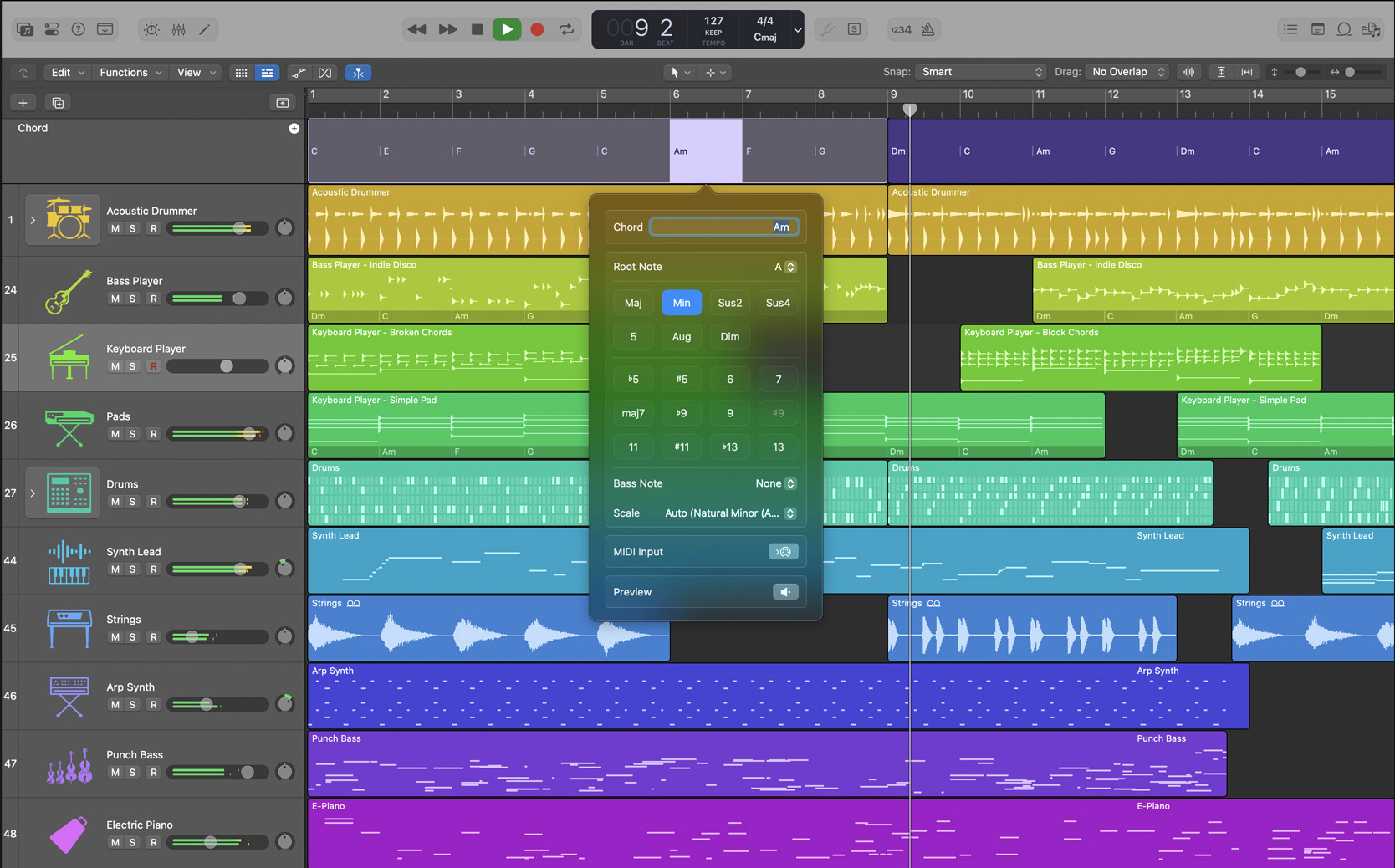
Ah. What else?
Importing big datasets.
I’ve got some medium-sized semi-automated imports going on - like blue plaques and desert island discs - but we need to import thousands and thousands of things.
Once you connect them all together, we’re looking at millions and millions of spans.
That’s a lot 😵
Yes. But databases are clever, and you can make this stuff scale if you do it right.
Have you done it right?
No 🫠
Oh.
Oh.
But it’s OK, this prototype is about working out how things might work, so the right way can be found.
Alright. There’s something else, though, isn’t there?
Yes. Scale isn’t just a data problem… it’s a UX problem.
You mean how to decide what to show, when there’s a lot of things that could be shown?
Precisely.
If we ask “what was happening in 1997?” the answer is pretty limited when there’s only a few spans in the system.
When there’s many many, it becomes a major filtering problem to work out what to show and what to hide, and how to make it make sense.
Wikipedia manages it…
It does, and that’s why some pages in Wikipedia are big lists of things. But this is somehow trickier.
Because the answers to some queries are massive 🤯
Yeah, I can see that.
I mean, if you show all the public figures in the system who lived in London at some point in their lives, you’d have a very big list…
Exactly.
So we need to have ways to shine the torch into the darkness and see just what’s in the light beam, not just turn on the floodlights and be overwhelmed 🔦
I guess lots of websites have this problem… like Twitter? The “firehose” problem?
Yeah, but Twitter - and similar things… YouTube, Instagram - have a built-in timeline paradigm, so you can show the most recent content by default.
This is like that, but with a less obvious timeline, because this is meant to step outside the timeline.
You want the completeness of Wikipedia, and the focus of Twitter.
Or “X”
Or “X”
I can’t believe I said that.
…
That makes me think, actually.
🏷️ Names
If you looked up “Twitter” in Lifespan…
…would it say “X”? Yeah.
It’s a bit like looking up “London” and wondering whether it should say “Londinium” at some point.
Or if the BBC goes from being “company” in 1924 to “corporation” in 1927… or whenever it was.
It’s called the “Ship of Theseus Paradox”.
Remind me.
It’s the philosophical problem of identity over time: if an object has all its parts gradually replaced, is it still the same object?
What makes something the same thing, rather than a different thing, when it changes?
I guess you and I are different things, physically, as we age? I mean, I’m not the same physical cells and atoms I was born. But I’m still “me”?
Yeah, according to ChatGPT…
If we take the weighted average across tissues, many estimates suggest that about 50% of your body’s cells are replaced every 7–10 years. But your neurons, eye lens, and some muscle cells stick around for life.
But point taken.
When a company merges with another company and renames itself to another company name, like “Orange” merging with “T-mobile” and becoming “EE” (Everything Everywhere, by the way).
The future’s bright 🍊
It was.
If you look up “Orange” in 2008, it’s called “Orange”… but in 2012 it doesn’t exist, because it’s now “EE”.
So we need a whole new way to declare relationships between things, so you can see that EE started in 2010, but was the result of a previous merge of other things.
That’s doable, though, right?
Yes, but it requires many-to-many connections, rather than one-to-one.
Bit of an edge-case? I mean, you don’t need to worry about mobile phone companies?
Yeah… but lots of things change and evolve in complex ways.
“Radiohead” used to be called “On a Friday”, but it’s the same people. Is that two things or one?
Same with
- “The Beatles” and “The Quarrymen”
- “Red Hot Chili Peppers” and “Tony Flow and the Miraculously Majestic Masters of Mayhem”
- “Glaxo Wellcome” + “SmithKline Beecham” = “GlaxoSmithKline (GSK)”
- “Google” becomes “Alphabet”
- “Facebook” becomes “Meta”…
“Marathon” becomes “Snickers”
Yeah.
- Lady Diana Spencer
- Gordon Sumner (Sting)
- Reginald Dwight (Elton John)
- Paul Hewson (Bono)…
I get it
- Stefani Germanotta (Lady Gaga)
- Richard Starkey (Ringo Starr)
OK, OK.
So we need to rethink things a bit, is what you’re saying?
Yes. But I think it’s doable.
Just need to change the model a bit so that things don’t have names baked-in quite so much… they can have names that are themselves spans.
And they don’t do that at the moment?
No. Names are primary required fields, and they’re fixed.
They’re the basis of URLs, too, which makes things interesting.
OK. Can we stop now?
Yes. My head’s full too.
There’s lots more though, isn’t there?
Yeah…
📋 List
So…
- ✅ Spans within spans (like your second year at university). That’s done.
- ✅ Groups of spans (like Desert Island Discs). That’s done.
- ✅ Places having geolocation metadata (so we properly know that London is in the UK). That’s sort of done.
- ✅ Family trees (so we know who your parents, children, grandparents, aunts and uncles are). That’s done.
- ✅ Time travel (so you can see what a span looked like at a particular date). That’s sort of done.
- ✅ Flickr image imports (so you can see your photos in time context). That’s sort of done.
- ✅ Imports from the Science Museum exhibit API. That’s sort of done.
- ✅ Governments/prime ministers/elections… that’s partly done.
- ✅ Importing books, films, TV programmes… that’s pretty much done.
- ✅ Importing Twitter archives… that’s party done…
- 🤔 Modelling mergers and name-changes… that’s not done…
- 🤔 Importing genealogy data… that’s not done…
- 🤔 Importing band gigographies… that’s not done…
- 🤔 Building stories like “the industrial revolution”… that’s not done…
There’s more, isn’t there?
There really is.
Sounds like you need help to step back, rethink all of this, and make a proper plan.
It does, doesn’t it?
But I can sort of see… something… some potential.
Me too.
I mean, we could import all of the contents of the Tate Modern’s exhibitions, with all the artists…
Yep.
And the BBC Archive…
Well… let’s not get over-excited…
And museum collections…
Yep.
And organisations would love the fact that their information is presented in new and dynamic ways…
Maybe.
And we could import major news events through history…
Yep.
And people would find new ways to explore and archive their family history…
Maybe.
And then it would be a self-perpetuating community, built on top of Wikipedia and all the other data out there…
…
And it would reach some sort of critical mass and…
…